
DC Brush Motors
From Hansen Corporation
Industrial applications use dc motors because the speed-torque relationship
can be varied to almost any useful form -- for both dc motor and regeneration
applications in either direction of rotation. Continuous operation is commonly
available over a speed range of 8:1. Infinite range (smooth control down to
zero speed) for short durations or reduced load is also common.
Read more ▸
DC motors are often applied where they momentarily deliver three or more times their rated torque. In emergency situations they can supply over five times rated torque without stalling (power supply permitting).
Dynamic braking (dc motor-generated energy is fed to a resistor grid) or regenerative braking (dc motor-generated energy is fed back into the dc motor supply) can be obtained with dc motors on applications requiring quick stops, thus eliminating the need for, or reducing the size of, a mechanical brake.
DC motors feature a speed which can be controlled smoothly down to zero, immediately followed by acceleration in the opposite direction -- without power circuit switching. And DC motors respond quickly to changes in control signals due to the high ratio of torque to inertia.
DC Motor types: Wound-field are usually classified by shunt-wound, series-wound, and compound-wound. In addition to these, permanent-magnet and brushless dc motors are also available, normally as fractional-horsepower dc motors. They may be further classified for intermittent or continuous duty. Continuous-duty dc motors can run without an off period.
PMDC Brush Motors
-
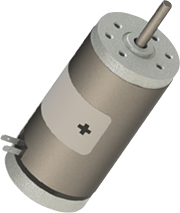
Series 116-1: 1.6 inch PMDC Brush Motor
A 1.6" diameter permanent magnet DC brush motor with standard catalog stall torque ratings are in the range of 19 to 78 oz-in, while no-load speeds range from 1,700 to 8,000 rpm maximum. Encoders with line counts up to 2048 are available to provide velocity and position feedback information. Reliability is further enhanced by long life, pre-loaded ball bearings.
Size: 1.6 inch or 40.3 mm
View Product View CAD
Peak Torque: to 78 oz-in or 55.1 Ncm -
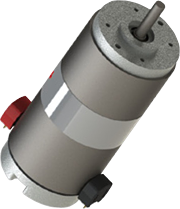
Series 121-1: 2.1 inch PMDC Brush Motor
A 2.1" diameter permanent magnet DC motor with standard catalog stall torque ratings are in the range of 60 to 180 oz-in, while no-load speed ranges from 2,100 to 8,000 rpm max. Encoders with line counts up to 2048 are available. Reliability is enhanced by long life, pre-loaded ball bearings.
Size: 2.1 inch or 54.2 mm
View Product View CAD
Peak Torque: to 180 oz-in or 127.1 Ncm


PMDC Spur Gear Motors
-
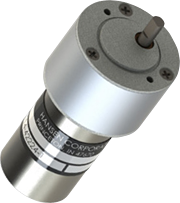
Series 114-4: 1.4 inch DC Brush Gearmotor with 2 inch Metal Spur Gearbox
Hansen offers an inexpensive, 1.4" diameter DC brush motor on our 2" diameter spur gearbox. This motor is offered in voltages up to 24 volts DC along with several optional features. 4 ratios are offered, 12:1, 48:1, 192:1 and 768:1.
Size: 1.4 in (35.7 mm)
View Product View CAD
Peak Torque: to 500 oz-in or 3.5 Nm -
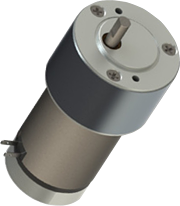
Series 116-4: 1.6 inch DC Brush Gearmotor with 2 inch Metal Spur Gearbox
Hansen offers our 1.6" diameter DC brush motor on a 2" diameter spur gearbox.
Size: 1.6 in (40.3 mm)
View Product View CAD
Peak Torque: to 850 oz-in or 6 Nm -
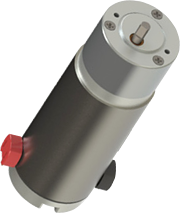
Series 121-4: 2.1 inch DC Brush Gearmotor with 2 inch Metal Spur Gearbox
Hansen offers our 2.1" diameter DC brush motor on our 2" diameter spur gearbox. This motor package is offered in a wide range of operating voltages and with 4 gear ratio options, 12:1, 48:1, 192:1 and 768:1.
Size: 2.1 in (54.2 mm)
View Product View CAD
Peak Torque: to 850 oz-in or 6 Nm -
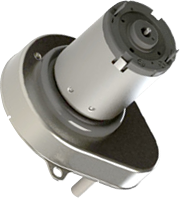
Series 148-5: PMDC Gearmotor with Synchron® Pear (C-Mount) Gearbox
Synchron permanent magnet DC motor mounted on our Synchron C mount gearbox. Hundreds of gear ratios are available ranging from 1.3:1 up to 6,000,000:1 with a maximum torque rating on most gearheads of 30 oz-in. For overload torque protection the gearheads may be selected with two-way slip clutches. The highly efficient DC motor has permanently lubricated sintered bearings and long life brushes.
Size: 1.1 inch or 28 mm
View Product View CAD
Peak Torque: to 30 oz-in or 21.2 Ncm -
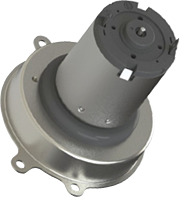
Series 148-6: PMDC Gearmotor with Synchron® Round (A-Mount) Gearbox
Synchron permanent magnet DC (PMDC) motor mounted to our round Synchron gearbox. Dozens of gear ratios are available ranging from 1.3:1 up to 720:1 with a maximum torque rating on most gearheads of 30 oz-in. For overload torque protection the gearheads may be selected with two-way slip clutches. The highly efficient DC motor has permanently lubricated sintered bearings and long life brushes.
Size: 1.1 inch or 28 mm
View Product View CAD
Peak Torque: to 30 oz-in or 21.2 Ncm





PMDC Planetary Gear Motors
-
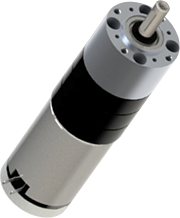
Series 116-8: 1.6 inch DC Brush Gearmotor with 2 inch Metal Planetary Gearbox
The Hansen series 116-8 gear motor matches our 1.6" diameter DC brush motor with a metal planetary gearbox. Gear ratios up to 642:1 are available. Encoders can also be added.
Size: 1.6 in (40.3 mm)
View Product View CAD
Peak Torque: to 2,124 oz-in or 15 Nm -
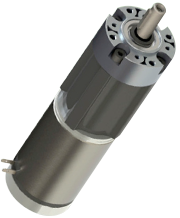
Series 116-9: 1.6 inch DC Brush Gearmotor with 2 inch Plastic Planetary Gearbox
The Hansen series 116-9 gear motor matches our 1.6" diameter DC brush motor with a plastic planetary gearbox. Gear ratios up to 642:1 are available. Encoders can also be added.
Size: 1.6 in (40.3 mm)
View Product View CAD
Peak Torque: to 566 oz-in or 4 Nm -
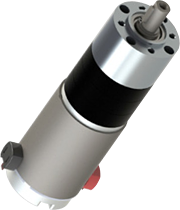
Series 121-8: 2.1 inch DC Brush Gearmotor with 2 inch Metal Planetary Gearbox
The Hansen series 121-8 gear motor matches our 2.1" diameter DC brush motor with a 2" diameter metal planetary gearbox. Dozens of ratios are available up to 642:1. Encoders can also be added.
Size: 2.1 in (54.2 mm)
View Product View CAD
Peak Torque: to 3,540 oz-in or 25 Nm



DirectPower™ Plus Brush Motors
-
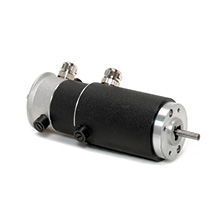
DPP240: 2.25 inch (57 mm) 48-60V Brush-type Permanent Magnet DC (PMDC) Servo Motors
Size: 2.25 inch or 57 mm
View Product Buy Now
Peak Torque: to 240 oz-in or 169 Ncm -
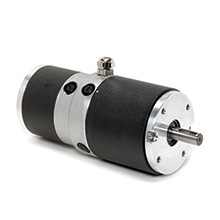
DPP640: 4.1 inch (106 mm) 48-60V Brush-type Permanent Magnet DC (PMDC) Servo Motors
Size: 4.1 inch or 106 mm
View Product
Peak Torque: to 240 oz-in or 169 Ncm -
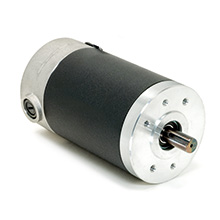
DPP680: 3.25 inch (82.5 mm) 24-60V Brush-type Permanent Magnet DC (PMDC) Servo Motors
Size: 3.25 inch or 82.5 mm
View Product Buy Now
Peak Torque: to 1100 oz-in or 776.8 Ncm -
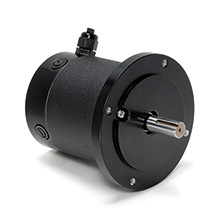
DPP700: 4.0 inch (102 mm) 24-90V Brush-type Permanent Magnet DC (PMDC) Servo Motors
Size: 4.00 inch or 102 mm
View Product
Peak Torque: to 2000 oz-in or 1412 Ncm -
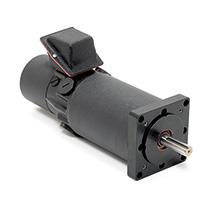
DPP720: 4.0 inch (102 mm) 60-120V Sealed Brush-type Permanent Magnet DC (PMDC) Servo Motors
Size: 4.00 inch or 102 mm
View Product
Peak Torque: to 2880 oz-in or 2034 Ncm